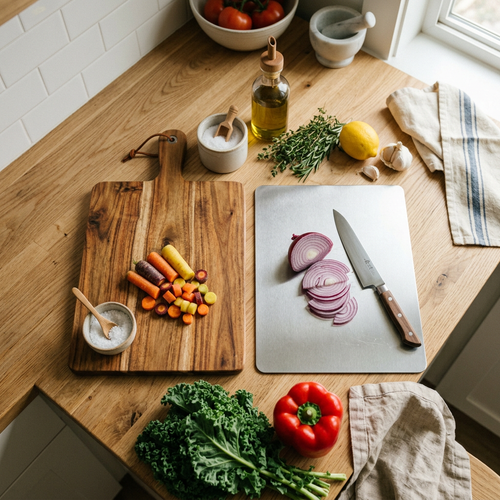
Wooden and steel chopping boards differ in surface hardness, moisture behaviour, knife edge wear and care routine. Cooks who search for a wooden vs steel chopping board need a comparison of those attributes. This guide compares both boards on each attribute and lists the care steps.
The guide covers the role of a chopping board, wooden board attributes, steel board attributes, a side-by-side table, care routines and the best use for each board.
Which chopping board is better, wooden or steel?
Wooden boards protect knife edges, while steel boards clean fast and resist moisture. The better board depends on the task: wood suits daily slicing, and steel suits messy prep and kneading.
What does a chopping board do in a kitchen?
A chopping board protects the counter, holds food steady and absorbs knife impact. Kitchen knife blades measure 56 to 62 on the Rockwell C hardness scale (HRC), so the board surface determines how fast the edge wears.
What are the attributes of a wooden chopping board?
A wooden chopping board has a softer, fibrous surface. Hardwoods register roughly 1,000 to 1,500 lbf on the Janka scale, and the fibres give slightly under the knife edge. The grain also grips food, which keeps slices steady.
What are the strengths of a wooden board?
- The surface protects knife edges during daily slicing of vegetables, fruit and herbs.
- The warm finish serves bread, cheese and snacks directly at the table.
- The grip holds round produce such as onions and tomatoes in place.
What are the limits of a wooden board?
- The fibres absorb water, so the board needs drying after every wash.
- Soaking and heat above 60°C cause cracks and warping.
- Knife marks accumulate in the surface over time.
What are the attributes of a steel chopping board?
A steel chopping board has a hard, non-porous surface. The surface repels moisture and odour, and a rinse and wipe restores the board between tasks.
What are the strengths of a steel board?
- The surface wipes clean in seconds after raw dough, spices or sticky ingredients.
- The board takes heavy use such as kneading, rolling and portioning.
- The flat surface stores upright in narrow spaces.
What are the limits of a steel board?
- The hard surface wears knife edges faster than wood.
- Knife contact sounds louder than on wood.
- Water spots appear unless the board is dried after washing.
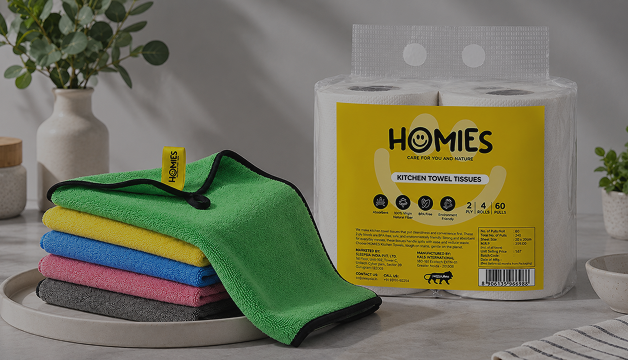
The image below shows the Homies kitchen and dining range.

How do wooden and steel chopping boards compare?
| Attribute | Wooden board | Steel board |
|---|---|---|
| Surface | Fibrous, 1,000 to 1,500 lbf (Janka, hardwood) | Hard, non-porous |
| Knife edge wear | Low | Higher |
| Moisture | Absorbs water | Repels water |
| Cleaning | Hand wash, dry upright | Rinse, wash, wipe dry |
| Maintenance | Food-grade mineral oil every 4 weeks | Dry after washing |
| Noise | Quiet | Louder |
| Suited tasks | Vegetables, fruit, bread, herbs | Dough, kneading, messy prep |
How do you care for a wooden chopping board?
Wash a wooden chopping board by hand in warm water with mild soap soon after use. Dry it upright so air reaches both faces, and rub in food-grade mineral oil every 4 weeks. Dishwashers, soaking and direct heat cause cracks and warping.
How do you care for a steel chopping board?
Rinse a steel chopping board right after use, wash it with mild soap and wipe it dry. Dry wiping prevents water spots. A soft board handles fine slicing, and the steel board handles heavy tasks.
How do cooks organise two boards?
Cooks organise two boards by task: a wooden board for fresh produce and bread, and a steel board for dough and messy preparation. Separate boards keep flavours apart and shorten clean-up.
Frequently asked questions
Which chopping board is better for knives?
Wooden boards are gentler on knife edges than steel boards.
Is a steel chopping board easier to clean?
A steel chopping board wipes clean faster, because the surface is non-porous. Washing and drying after every use keeps the board spotless.
Does a wooden chopping board go in the dishwasher?
A wooden chopping board needs hand washing. Dishwasher heat and moisture crack the wood.
Which is the better chopping board for each task?
The better chopping board matches the task: wood for daily slicing and edge protection, steel for dough and messy preparation. The Homies range includes a wooden chopping board and a steel chopping board, and the kitchen and dining collection lists the remaining prep essentials.